By Guus , 16 October 2009

Dane Boersma.A co-founder of Dutch Bros., a coffee chain at the West Coast, has died from Lou Gehrig's Disease.

The Associated Press: "Travis Boersma said his brother, 55-year-old Dane Boersma, died Thursday morning at his home in Grants Pass.

The Boersmas started Dutch Bros. pushing a coffee cart up and down the streets of Grants Pass. They started franchising the company in 2000. It has since grown to more than 150 coffee stands in seven states, with more than $50 million in sales last year."

Dane Boersma was born in Lynnwood, California and he is a third generation Dutch American. When he was diagnosed with ALS he started Dane's Drive to raise funds for research to find a cure for ALS. Mr. Boersma is survived by his wife, Sandy, a daughter and two sons.

Topic
By Guus , 14 October 2009

I watched Argentina - Urugay with some very nervous friends tonight. We watched the game online on two monitors in the living room.

For a couple minutes I was cheering for the wrong team until I realize that Argentina was playing in different shirts this evening. I quickly corrected myself after some deadly looks from my friends when Urugay almost scored.

Luckily Argentina won (1-0) so it was a fun evening. With this win Argentina qualified for the World Cup in South Africa next year. It will be fun to watch those games next summer.

Topic
By Guus , 14 October 2009

Corine's Cafe, Mooresville, NC.Last week we visited Corine's Cafe in Mooresville, North Carolina, one of nearly 40 Dutch restaurants, bakeries and stores in the United States that we know of.

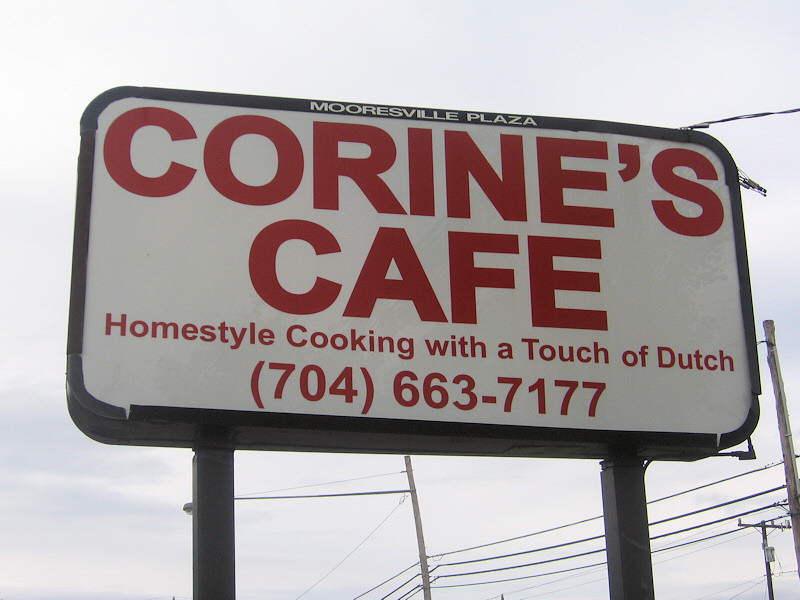
Corine's Cafe is located in Mooresville about 30 minutes north of Charlotte, NC. A sign with big red letters marks the spot: 'homestyle cooking with a touch of Dutch'.

Owner Corine Croxell is a Dutch native and her husband Dennis works for a NASCAR team. The cafe captures the family spirit by featuring orange Dutch flags and NASCAR racing memorabilia. The classic American dining room is decorated with 1950's bar chairs and a black and white tiled floor and the cafe was used to create a TV commercial with Dale Earnhardt Jr., a NASCAR racer.

A touch of Dutch
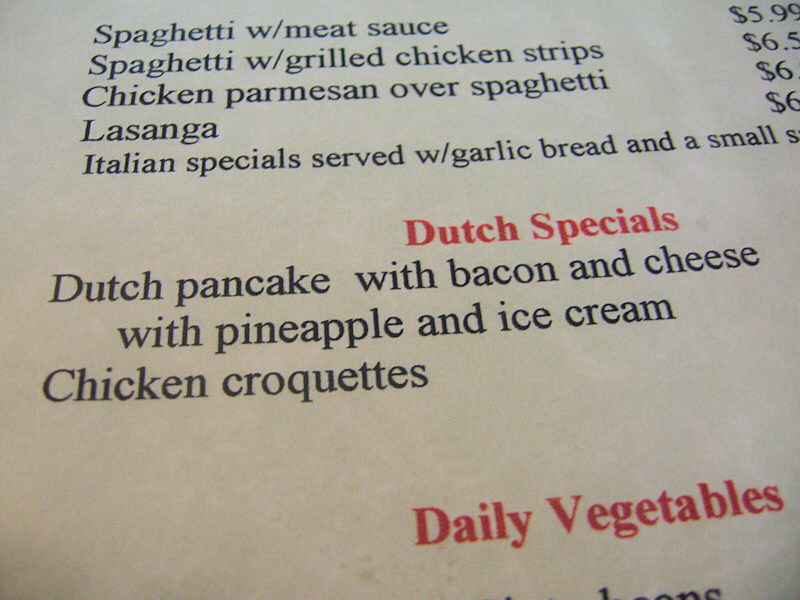
The frontpage of the menu has a picture of classic Dutch windmill and Dutch items on the menu include bitterballen, kroketten, Dutch pancakes, Dutch apple pie and home-made stroopwafels.

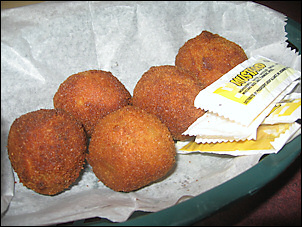
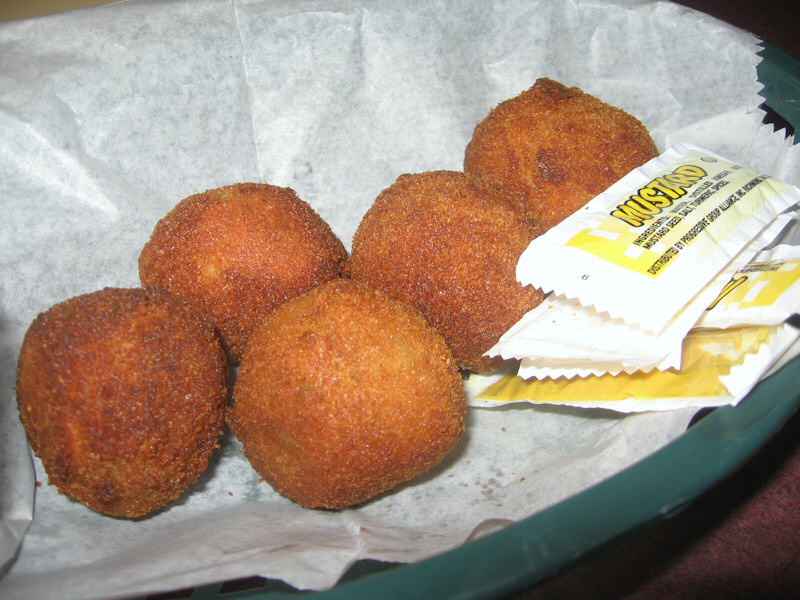
The waitress gave us a friendly warning: "the bitterballen and the kroketten are pretty much the same thing". She was right of course, and it was nice to warn us, but we ordered both anyway. The bitterballen are home-made and delicious. They're filled with chicken, parsley and spices. While their crust was a bit thinner than the mass produced ones in the Netherlands, they had a really nice bite to it. Of special note is the mustard used. Corine's Cafe use exactly the right type of mustard for bitterballen and kroketten -- spicy and not too sweet.

Mrs. Croxell is a hands-on manager and starts her day very early bake and prepare for breakfast. "I always have to train the American cooks on how exactly to prepare a pannenkoek", she said. Her lessons paid off -- the pancake was excellent.

We tried the cheese and bacon version and the structure of the pancake was classical Dutch: fluffy, with a great flavor and a little thinner than the American version. In the Netherlands pancakes are served in many different styles and flavors. While using fried bacon instead of smoked spek is definitely American it works out nicely and this is a true Dutch-American pancake.

Corine's Cafe, Mooresville, NC.Mrs. Croxell worked in a pancake house in the Netherlands. She has worked in restaurants from an early age and in August 2005 she started Corine's Cafe. Through the years she has brought many Dutch items from Holland to North Carolina to decorate the cafe; even the pen-holder at the register is a wooden shoe. Mrs. Croxell grew up in Waterland, a municipality just north of Amsterdam, and in the hallway there are a number of photographs of Marken and Monnickendam.

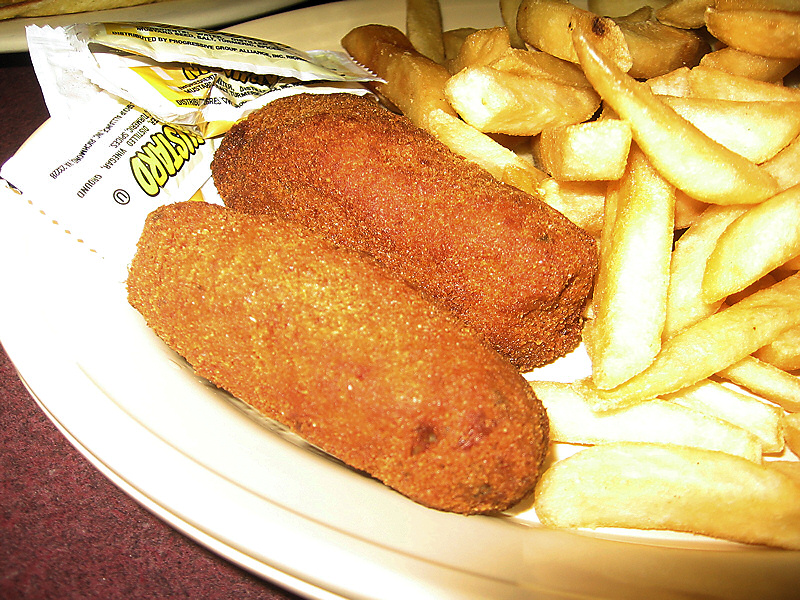
Corine's Cafe is a casual eatery with 225 seats and Mrs. Croxell said they are frequently full. Breakfast is especially popular. They have a lot of regular guests. The Dutch snacks are popular for lunch, for example the kroketten with French fries. The kroketten are also home-made and except for the size and shape are very similar to the bitterballen, as is the case in the Netherlands.

Dutch desserts
The stroopwafels, made one-by-one by Mrs. Croxell in a small waffle iron, are a real treat. They are different from store bought stroopwafels (a little crispier) and remind of the freshly baked stroopwafels on the markets in the Netherlands.

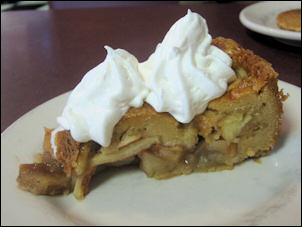
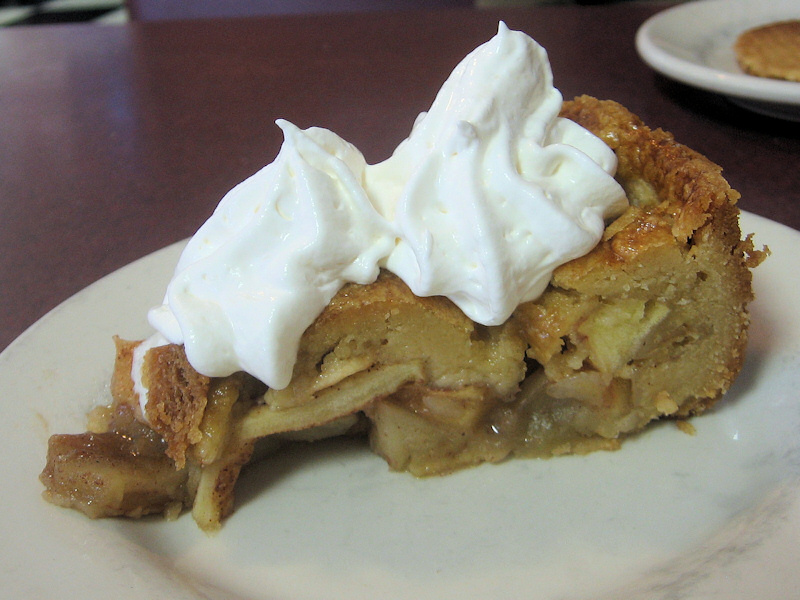
Finally, the apple pie is as Dutch as it gets -- this is the real thing. For a real 'Dutch treat' we had it heated up with a scoop of whip cream on top.

Corine's Cafe is definitely worth a visit. For a real European experience you could combine a visit with a trip to the Ikea a few miles away.

Corine's Cafe
559 E. Plaza Drive
Mooresville, NC
View on map

Bitterballen at Corine's Cafe, Mooresville, NC.

"Corine's Cafe: homestyle cooking with a touch of Dutch".

Bitterballen at Corine's Cafe, Mooresville, NC.

Bitterballen.

Menu with Dutch specials.

Dutch specials on the menu.

Kroketten at Corine's Cafe, Mooresville, NC.

Kroketten.

Corine's Cafe, Mooresville, NC.

Home-made Dutch apple pie (appeltaart).

By Guus , 11 October 2009

I cooked a couple of dishes tonight, and froze a lot of it for the week. When cooking Indonesian it's much more efficient to cook a couple of different recipes at the same time since there is so much cutting, chopping and preparing involved and often ingredients are similar.

I got a nice piece of chuck roast from the butcher and made two meat stews: rawon daging or zwarte rundvleesstoof and daging smoor. In addition I prepared a home-made satay sauce which was fun to do and marinated a number of chicken satay skewers.

Yesterday we spent the day on the road; we went to the new Ikea there and picked up a book case.

Topic
By Guus , 10 October 2009

Last weekend was the 2009 Rensselaerswijck Seminar in Albany, NY. This year the annual Seminar had a two-day program with an opening on Thursday evening with Russell Shorto and speakers on Friday and Saturday.

The seminar took place in New York State Museum's Carole Huxley Theatre. Your correspondent had the opportunity to attend the Saturday session with a diverse group of attendees ranging from professional historians to interested people from all walks of life. According to Charles Wendell PhD, President and Chairman of the New Netherland Institute, the complete registration for the two days of the seminar was 180, one of the best numbers in the history of the event.

The program started at 9.00 A.M. and the friendly atmosphere was set with a birthday recognition of Jippe Hiemstra, chairman of the Institute’s 2009 Committee. In the introductory words Dr. Wendell led a rousing cheer for the Van Voorhees family who organized their 5-yearly event to coincide with the Seminar, followed by recognition of the many attending societies and organizations.

No 'Holland on the Hudson'

The first speaker was Jan Folkerts MA, general manager of the municipality of Littenseradiel in Friesland and a New Netherland researcher.

Until the 1980 most researchers considered the Netherlands to be homogeneous, but in reality there are significant differences culturally, politically and economically between the various regions in the Netherlands. When thinking about the Dutch Republic in the 17th century the province of Holland is often considered to be representative of the whole Republic, since that is where the power center of the country was. However, colonists and farmers mainly came from other provinces as Mr. Folkers convincingly showed using various charts and graphs.

"Whatever New Netherland might have been, it was certainly not 'Holland on the Hudson'".
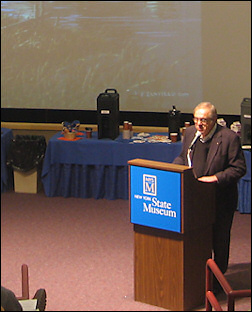
Charles Gehrling: "We're still finding stuff!"

Charles Gehring, PhD, director of the New Netherlands Project, spoke next. He talked about the origin of the sources that the NNP is translating, and some of the events that impact caused documents to disappear such as a 1674 reorganization of the WIC and a fire in 1911.

About the documents: "Some of them are still out there -- those that weren't boiled up and made into new paper. We're still finding stuff!"

Dr. Gehrling's talk was informative and very entertaining. Mr. van Slichterhorst, the main subject of the talk, had a hard time dealing with the Indians according to a related lawsuit filed in the Netherlands. Negotiating with the Indians was expensive to him personally: large amounts of gifts, food and drinks were provided. "So, this would be an early example of a protection racket". Dr. Gehrling mentioned an interesting project by the Universiteit van Leiden, http://www.brievenalsbuit.nl.

Henry Hoff, the editor of The New England Historical and Genealogical Register, spoke about researching family history in New York and New Jersey. His hand-out contains many useful links to genealogy research.

After the break Dr. Starna introduced Dr. James W. Bradley as the recipient of the annual Hendricks Award for his book Before Albany.
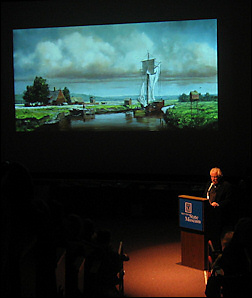
Len Tantillo

Len Tantillo showed many of his beautiful works and spoke about the research that went into creating these paintings. He described how archeology and the translated documents work together, for example to show that people in Fort Orange lived a wealthy live, not all that differently from their peers in patria, the Dutch Republic.

To paint canoes Mr. Tantillo did research in Canada on how to make canoes (using elm) and he worked with the Scheepsvaartmuseum in Amsterdam to learn what a Dutch bark looked like.

Martha D. Shattuck PhD, editor for the New Netherland Project, wrapped up the presentations with a talk about Rensselaerswijck.

New Netherland dinner

The evening reception and dinner was in the Hampton Inn and Suites and Indonesian food was provided by Yono's. Appetizers included krupuk with peanut sauce and Indonesian meatballs -- a nice touch for a partially Dutch crowd, since Indonesian food is not common in the United States.

A special Half Moon daalder coin was presented to everyone at the dinner; a great present by Dr. Andrew Hendricks, Chairman of the New Netherland Museum.

William (Chip) Reynolds, Director of New Netherland Museum, spoke about the work done with the Half Moon ship that he is captain of. Technical problems with the projector did not stop him from conveying what kind of preparation and guts it took Henry Hudson to cross the ocean and explore the Hudson river. Dr. C. Carl Pegels, Professor Emeritus, SUNY at Buffalo, NY. received the Alice P. Kenney Memorial Award for his excellent online collection of Dutch-Americans.

After the main event smaller groups stayed until late in the night. In the words of the Dr. Wendell: "We consider the entire event to have been a great success" -- we agree.
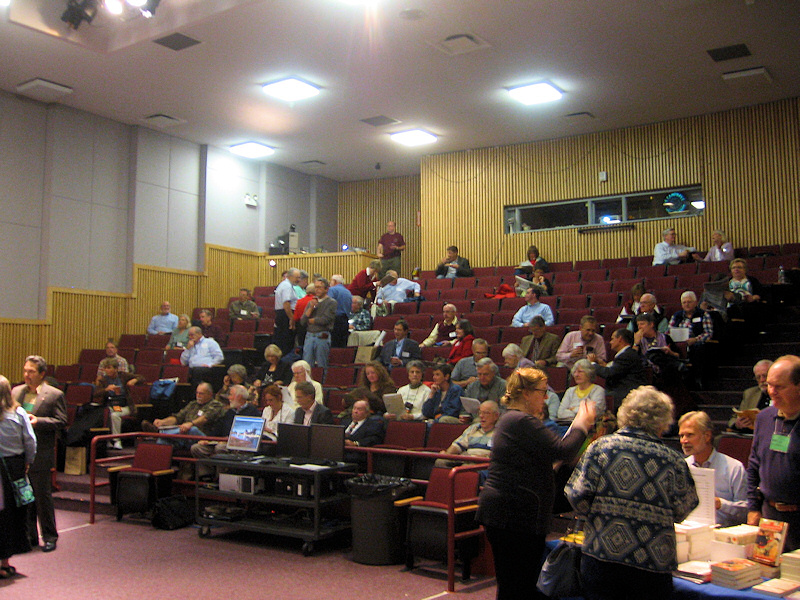
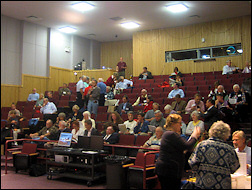
The audience.

The audience in New York State Museum’s Carole Huxley Theatre.
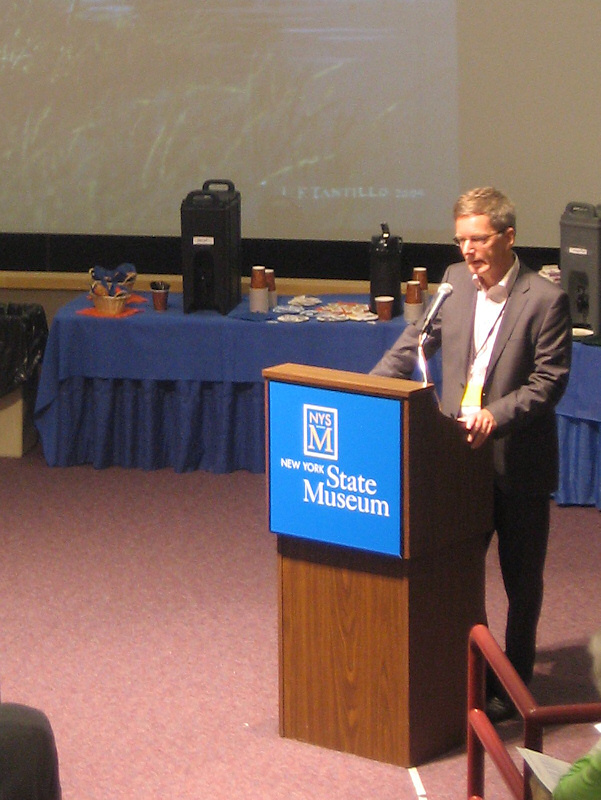
Jan Folkers.

Jan Folkers: "Regional Patterns in Dutch-American Culture"
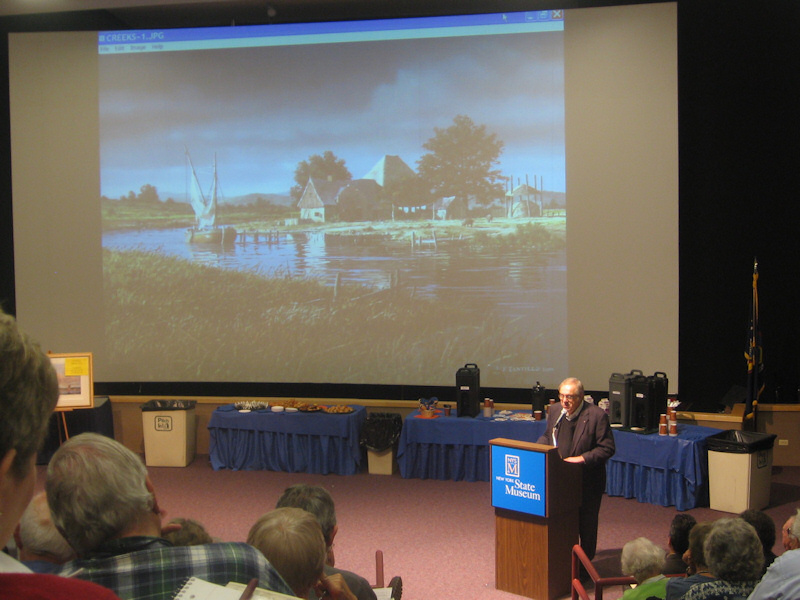
Charles Gehrling.

Charles Gehrling: "Brant van Slichtenhorst’s Indian Grievances: Mohawks and Mahicans at Rensselaerswijck"
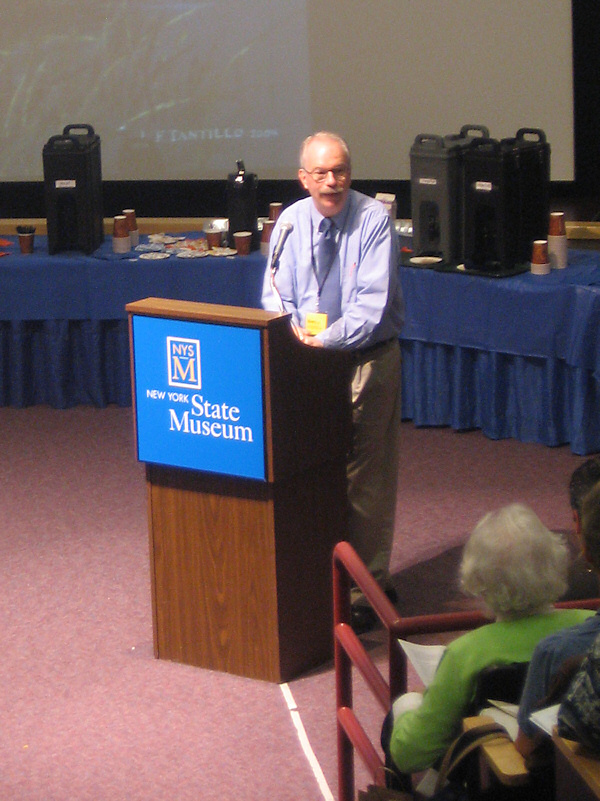
Henry Hoff.

Henry Hoff: "Researching Dutch Families in New York and New Jersey"
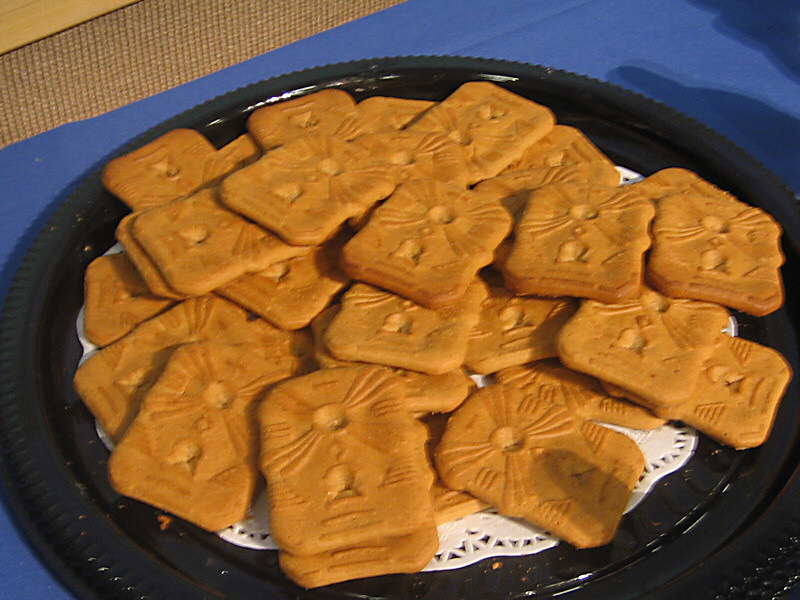
Speculaas.

Appropriate speculaas cookies during the break.
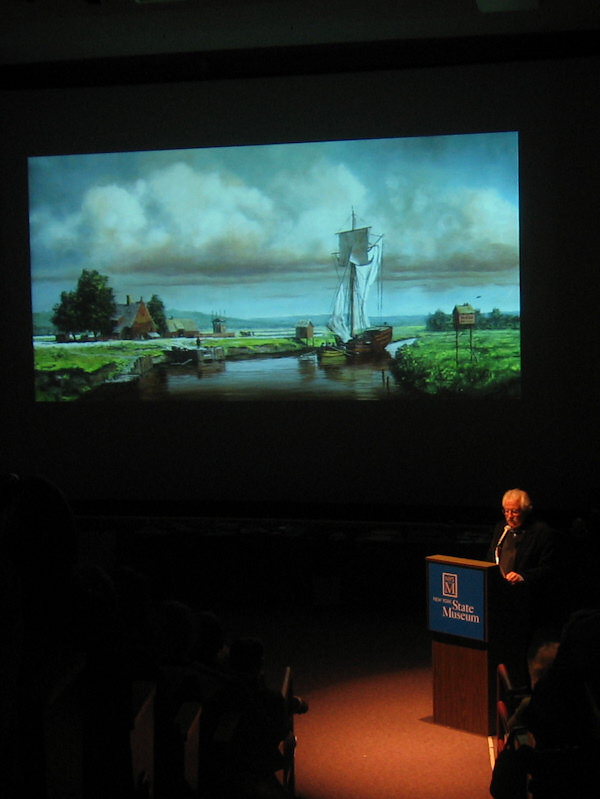
Len Tantillo.

Len Tantillo. In the background a projection of one of his works.
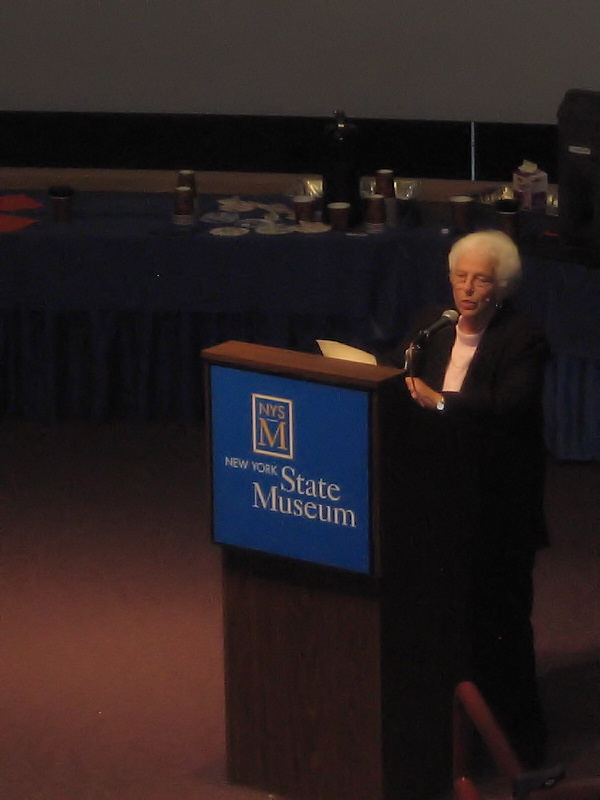
Martha Shattuck.

Martha Shattuck, PhD: "From Dutch Patroonship to English Manor"
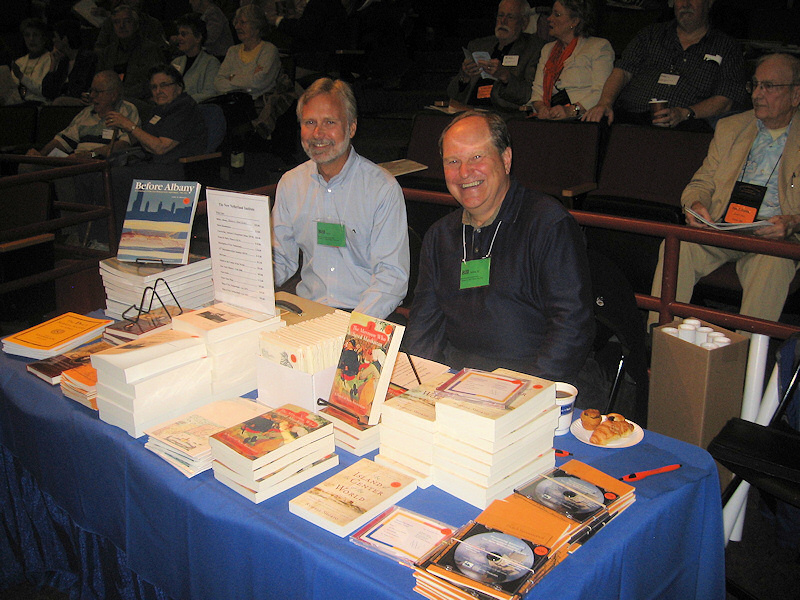
Board members selling books.

Topic
By Guus , 8 October 2009

Dutch Utopia.Last weekend the exhibit Dutch Utopia: American Artists in Holland, 1880-1914 opened for the public in the Telfair Museum of Art in Savannah, GA. With over 70 paintings the exhibition examines the work of forty-three American painters drawn to Holland during the late nineteenth and early twentieth centuries:
"Dutch Utopia includes works by artists who remain celebrated today, such as Robert Henri, William Merritt Chase, John Twachtman, and John Singer Sargent, along with painters admired in their own time but less well-known now, including accomplished women like Elizabeth Nourse and Anna Stanley, as well as George Hitchcock, Gari Melchers, and Walter MacEwen, who built international reputations with salon pictures of Dutch landscapes and costumed figures. These artists were among hundreds of Americans who traveled to the Netherlands between 1880 and 1914 to paint and to study. Some lived in Holland for decades, while others stayed only a week or two; but most passed quickly through the major cities to small rural communities, where they created picturesque idylls on canvas."

According to GPB.org the exhibit took five years of planning and research and it is the largest collection of paintings by American artists of the Netherlands that has ever been assembled.

In conjunction with Dutch Utopia there is a separate exhibition in the museum on the works of Walter MacEwen, one of the most highly decorated American artists of the late nineteenth century. He is best known for his depictions of rural Dutch life:

"Early in his career, MacEwen had also opened a studio in Hattem – a quiet medieval village in the Dutch province of Gelderland, where he spent his summers. MacEwen’s exposure to the work of seventeenth-century Dutch masters, as well as to the artists of the contemporary Hague School, exerted a considerable impact upon his developing style, and agrarian village life in Hattem inspired dozens of Dutch genre paintings that would come to define MacEwen’s mature career."

Walter MacEwen: An American Expatriate Revisited, which features additional works from Mr. Starke’s collection as well as pieces from other private and public collections and nicely complements works on display in Dutch Utopia.

The exhibition will also travel to the Taft Museum of Art in Cincinnati, the Grand Rapids Art Museum, and the Singer Laren Museum in the Netherlands.

Telfair Museums, Dutch Utopia: American Artists in Holland, 1880-1914
http://telfair.org
through January 10, 2010 in Georgia.

Topic
By Guus , 7 October 2009

Halve Maen.Senate resolution S.Res.254 we wrote about earlier was officially approved yesterday.

The Hill has an article about the Dutch American relations, specifically around Afghanistan:

"President Barack Obama is weighing a difficult decision to send more American troops to Afghanistan at a time when the Netherlands is preparing to pull its own soldiers from the war-torn country next year. "

The passage of the resolution by the Senate and the corresponding House Resolution (H.Con.Res.178) caps off the 8 month celebration of NY400 events in New York and the Netherlands to mark the shared history and shared values between the United States and the Netherlands.

Topic
By Guus , 4 October 2009

Yesterday I attended the Rensselaerswijck Seminar in Albany, NY. That was so much fun!

A very friendly crowd and interesting topics. I met a number of people I've been wanting to chat with for a while.

During the day there were presentations around the topic of New Netherland, the Dutch colonies in the 17th century in New York State. In the evening there was a reception and an Indonesian dinner. Later I went to a bar with three fun researchers (French, Dutch American and American) and we stayed till late.

Today I plan to visit the 1609 exhibition in the museum here, perhaps the Old Church and then travel back to New York LaGuardia where my flight departs at 7:45 pm. It's been a fun week but I'm looking forward to be together again.

Topic
By Guus , 2 October 2009

The last time I was in Albany, NY was 11 years ago, the summer that Sasha and I first met. Tonight I arrived here alone for a short stay in between work and travel back home on Sunday.

There's a seminar of the New Netherlands Institute in Albany tomorrow so tomorrow I'll be listening to a number of presentations on the history of New Netherland, the area of New York City and Albany in the mid-1600's.

On the way to here I drove past Kingston and Tannersville, two places we have fond memories of.

It's funny to see so many Dutch names and half-Dutch names in the names of villages and streets. One of the exits of the toll road is called Amsterdam.

Topic
By Guus , 30 September 2009

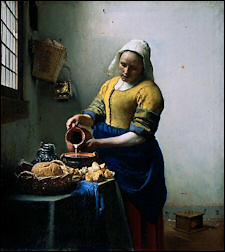
The Milkmaid.Friday night was a busy night at the Metropolitan Museum of Art in New York. Many people took the opportunity to see one of the world's most popular paintings, the Milkmaid (De Melkmeid) by Johannes Vermeer. Dutch in America visited the exhibition around of this work that was loaned to the Metropolitan Museum by the Rijksmuseum in Amsterdam in honor of the NY400 celebrations.

The exhibition begin with copies of the 36 known Vermeer paintings, five of which are in the permanent collection of the Met. The next rooms in the small gallery show the six Vermeers along with other paintings from that era. The exhibition is curated by Walter Liedtke, an Vermeer expert and accompanying the show is a 36-page catalogue by Liedtke that takes an original look at this beautiful painting.

It's rare to see so many Vermeers close by each other: 9 in the same city (The Frick Collection, a few blocks up the street, also houses 3 Vermeers). Today NLNY had an interview with the Dutch Consul General Gajus Scheltema in New York, and it mentions that the exhibition is drawing about 6,000 visitors per day.

Metropolitan Museum of Art, Vermeer's Masterpiece The Milkmaid
http://www.www.metmuseum.org
through November 29, 2009

Topic